
Watch This First
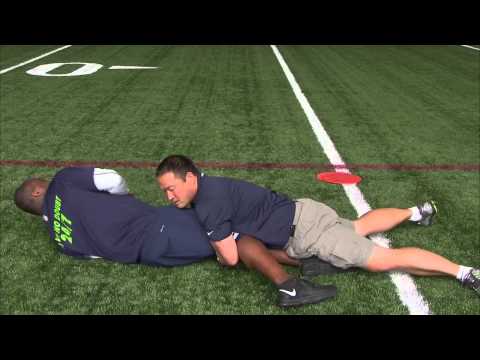
Before you read anything else on this page, watch the full Hawk tackling program. Every term, cue, and drill below comes from this video. Players: first ten minutes minimum before we hit the grass. Coaches: all of it.
The Three Non-Negotiables
You must know these before you line up. If you cannot say them back to a coach, you don't play.
Head Outside, Never Across
When you make contact, your head goes to the side or behind the ball carrier. Never across his body. The shoulder does all the work — the head stays out of it. This rule keeps you safe and it keeps the ball carrier safe. We do not bend it for anyone.
"Head out. Every rep. Every game."
Strike Zone: Knees to Armpits
Think of a baseball strike zone — knees to armpits. That's where your shoulder lands. Above the armpits is the head and neck. Below the knees is a leg whip. Neither is legal, and neither is Hawk. Every shoulder strike you throw lands inside that box.
"Knees to armpits. Every hit."
Wrap. Squeeze. Drive for 5.
The shoulder is the start of the tackle, not the finish. Both arms wrap around him. You squeeze his thighs through your chest. Then you drive your feet for 5 more steps until he's on the ground. A shoulder hit without a wrap is a missed tackle with a big sound.
"Wrap. Squeeze. Drive."
The Four Cues You'll Hear
Every practice. Every drill. A thousand times a week. Say them out loud so they live in your body.
Before the Contact — Getting There
A tackle is won before you touch him. How you close on the ball carrier decides whether the hit is Hawk or a whiff.
Track the Near Hip
The near hip is the hip of the ball carrier that's closest to you. That's your aim-point. Not the ball. Not his eyes. Not his number. The near hip. If you track the near hip on an inside-out angle, your shoulder will end up in exactly the right place when you arrive.
Eyes on the near hip the whole way. Shoulders square. Help behind you.
Run & Gather
You run hard at the near hip, then gather your feet a few yards before contact so your hips are under you and your shoulders are square. You never stop. You never "break down" and pose. You shorten your stride and get balanced so you can strike. Arrive balanced and in leverage, not stopped.
Run hard → gather → strike. That's the rhythm of every Hawk tackle.
The Six Hawk Tackles
Same rules. Same cues. Same strike zone. The only difference is the finish — and you pick your finish based on where you're coming from and what the ball carrier is doing.
Hawk Tackle
Shoulder through the thighs. Head outside. Wrap and squeeze. Drive for 5.
He goes down because his legs are gone.
Hawk Roll Tackle
Basic Hawk tackle, then roll through him and use his own momentum to take him to the ground.
Track → tackle the thighs → roll.
Hawks Lift Tackle
Basic Hawk tackle, then hook the opposite leg with your off hand and lift. Left shoulder tackle = right arm lifts.
Lift kills his base — he can't drive forward without feet on the ground.
Profile Tackle
No shot at the thighs — aim up to the near jersey number. Shoulder on the number, wrap, drive for 5.
Always a clean hit inside the strike zone. This is the tackle for scramblers and crossing receivers.
Compression Tackle
Each of you hits the target closest to you — first man on the near hip, second man on the near number.
Second man in = shark on the ball. Rip, strip, punch, jam. Get the ball.
Crossface Hawk Tackle
Don't reach. Strike with the opposite shoulder — whichever side he's on at contact is the shoulder you use.
Head still outside. Shoulder changes sides. Arms still wrap.
Why We Tackle This Way
Two reasons. Both important.
1. Safety
Hawk tackling takes the head out of the tackle. No helmet-first contact. No crown strikes. The shoulder does the work and the head stays out of the way.
This keeps you safe — your neck, your brain — and it keeps the guy you're hitting safe. We play this game a long time. We want every one of you walking off the field after every game, and still walking when you're 50.
2. We Can Install It Without Pads
Pete Carroll designed Hawk tackling so it can be drilled in shorts and T-shirts. That's exactly what Texas HS spring is — no pads, full speed.
That means by the time August pads come on, you already know the technique. We don't start from scratch in the fall — we install all spring and refine all summer. Our tackle technique is live and sharp before your first pad ever goes on.